GEPLAN Suite
JUBAP.Net, the organization behind the GEPLAN suite, is today a complex-systems intelligence centre focused on Operational AI Integrity and early-warning regime-change detection. Its origins lie in the early 2000s — in a Mexico that was not yet speaking the language of “Industry 4.0,” but was already building a serious software and industrial-technology base.

Mexico before Industry 4.0
By the mid-2000s, Mexico was not yet speaking the language of “Industry 4.0,” but it was already building a meaningful software and industrial-technology base. Official planning documents from the period described a national ICT market expected to grow by around 12%, with software forecast to grow faster, at about 19%, while the sector already employed more than 137,000 people. Mexico had launched PROSOFT in 2002 to strengthen the software industry, and by 2005 had formalised MoProSoft as a national process model for software development and maintenance. By 2006, PROSOFT was already supporting more than 330 projects and thousands of companies, most of them small and medium-sized firms.
This mattered because the country was not relying only on imported enterprise software. Mexico already had a real software ecosystem: large firms such as Softtek, Grupo Tress and Zentrum, but also hundreds of smaller firms building custom solutions for logistics, manufacturing, retail, transport, fuel distribution and industrial operations. States such as Nuevo León, Guadalajara, Monterrey and Baja California were becoming important technology clusters, producing growing numbers of engineers and software developers while benefiting from proximity to the United States.
It was also a particular moment socially. Before the worst years of the drug war and generalised insecurity, Mexico was seen by many international professionals as an attractive place to live and work remotely, even before the term “digital nomad” became common. That was also the case for the founders of JUBAP.net and The Integral Management Society SAS. After working in Europe, including at the Nokia R&D center in Barcelona, and spending time in the United States, they eventually established themselves in Veracruz, Mexico. From there, they built systems not only for PEMEX-related logistics, but also for Latin America and the United States, working with Mexican developers who had experience in medium and large systems for companies such as CSAV and other logistics-intensive organisations.
PEMEX itself was operating in a highly digital and operationally demanding environment. Its 2008 annual report describes telecom modernisation, SCADA support, satellite communications, internal logistics and franchise-monitoring systems, and even a NASA-supported GEO PEMEX 3D viewer for emergency response and operational maintenance. In the same period, Invensys opened a gas-operations centre in Reynosa to support PEMEX and described Burgos as the largest SCADA system it had installed in Latin America. The relevant context is therefore not a “digitally empty” Mexico, but a large industrial landscape where major operators, vendors and local teams were all building serious control, monitoring and integration capabilities.
An installed suite with a SaaS mindset
GEPLAN was architected in an era before public cloud, commercial IoT platforms and ready-made APIs, yet it behaved conceptually like an early SaaS for industrial operations. It was delivered as an on-premise, installable suite based on Delphi, ASP.NET and MySQL, organised into interoperable modules for logistics operators, workshops, warehouses, fleets and service stations. The 2008 catalog already describes a coherent environment: inventory and budgeting, vehicle maintenance, logistics planning, fuel-consumption control, volumetric management, ERP-style integration, remote access and centralised operational reporting.
Because standard IoT stacks did not yet exist, the team relied heavily on reverse engineering to connect hardware, dispensers, telemetry devices and legacy SCADA environments directly into GEPLAN. The result was a de facto pre-IoT integration layer, reinforced by extensive scripting and early RPA-style automation to move data between industrial devices, back-office systems and field users without manual re-entry.
Stock control and operational budgeting as the base layer of the suite.
Workshop, preventive and corrective maintenance tied to fleet readiness.
Route, trip and dispatch coordination across operators and field teams.
Consumption tracking and control across vehicles and operations.
Volumetric control for service stations and hydrocarbon movements (GEPLAN/V).
Modular architecture, pre-microservices
Technically, GEPLAN adopted a modular architecture designed to be adapted for different clients and operational contexts, even if the language of microservices was not yet in use. Modules such as GEPLAN/V for volumetric control could be deployed as part of a larger suite or as standalone components tightly integrated with existing infrastructure.
GEPLAN/V was a relatively advanced concept even by current standards. It could read dispensers from multiple brands such as Wayne and Gilbarco, integrate tank telemetry, monitor opening events, pressure and fuel levels, connect to PEMEX for transport, loading and unloading monitoring, and integrate invoicing with PEMEX franchise workflows. It also supported POS, ticket printing, inventory control and complete service-station management. What made it distinctive was not that each feature was unique by itself, but that all of them were integrated into one practical environment almost two decades before industrial IoT became mainstream.
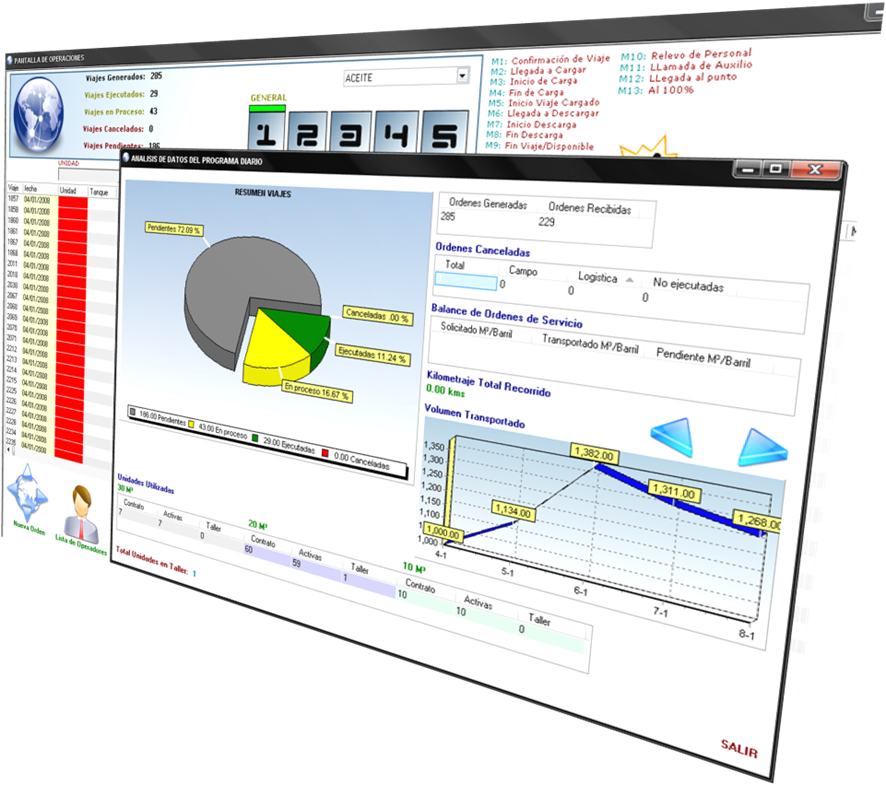
Similarly, the private fleet-control environment developed around GEPLAN went beyond standard GPS tracking. It connected transport companies, dispatch centres, workshops, maintenance, fuel control, drivers, inventory and operational reporting. The PEMEX / TETSA control-centre document shows the same logic in live operation: Omnitracs satellite telemetry, data mining, alerts, reporting, electronic work orders, secure communications, evidence attachments, operational alerts and linkage to PEMEX estimation workflows.
SaaS as consulting-plus-software
What made GEPLAN particularly close to a SaaS model was not only its modularity but the way it was commercialised and implemented. Clients did not simply receive software licences: they engaged in a structured consulting process that began with job-profile mapping, process discovery and organisational re-engineering. In many cases, this journey led to ISO 9001-style process formalisation as a first step, before fully tailoring and deploying the system to the refined operational model.
The suite was therefore “consumed” together with organisational consulting, with JUBAP.Net acting as both software provider and integrator of management practices. This consulting-plus-software approach aligned strongly with the meaning of The Integral Management Society: a focus on managing the whole system rather than a single tool or department.
Commitments based on value, not features
Commercially, the company structured its commitments around value creation instead of feature delivery. Contracts did not centre on a checklist of functionalities; they focused on concrete business KPIs such as reducing inventory shrinkage, increasing the efficiency of scheduled trips, tightening fuel control or improving fleet availability.
The promise to each client was that a given module or configuration would generate measurable operational improvements, not just additional screens or reports. This value-based orientation pushed the engineering teams to design GEPLAN as a living part of the operation, continuously refined through field feedback, rather than as a static IT product. Over time, that discipline of tying technology architecture to real-world behaviour became the foundation of JUBAP.Net’s current work in Operational AI Integrity and early-warning regime-change detection, where systemic shifts are identified not by abstract theory but by their concrete operational signatures.
Chicontepec: ambition and outcome
The broader Chicontepec programme did not meet its original ambitions, and that should be stated clearly. The ASF’s 2010 performance audit describes Chicontepec as a strategic response to Cantarell’s decline, representing 40% of the country’s hydrocarbon reserves, with a plan based on drilling 16,000 development wells. The same audit explains that well productivity was very low — around 0.1 to 0.3 thousand barrels per day per well — and concluded that production targets were missed, and that the productive return from 2002 to 2008 was only 2.5 centavos for every peso invested.
That failure should be acknowledged directly. But it does not make the associated digital and operational systems irrelevant; if anything, it shows how ambitious the surrounding logistical and decision environment really was.
A fair international reading is this: GEPLAN was a technically serious, Mexican-built integration layer, developed in an environment where the country already had growing software clusters, formal process models, large industrial telecom and SCADA deployments, and domestic firms capable of building custom systems for demanding corporate and industrial use cases. In that sense, GEPLAN belongs to the early wave of practical industrial digitalisation in Latin America — before the later vocabulary of IIoT, control towers and Industry 4.0 made those architectures easier to describe.
2008 user manuals & suite catalog
Original period materials — 2008 GEPLAN user manuals and the JUBAP.net GEPLAN Suite catalog:
GEPLAN TALLER v6.1 — Manual del Usuario (Versión B).pdf
Tegrity.AI — GEPLAN Suite in 2008.pdf

Historical account (2006–2010). The client for the PEMEX-related work was TETSA (Transportes Especializados de Toluca, S.A. de C.V.), the hydrocarbon-transport concessionaire operating in PEMEX’s northern region; GEPLAN was a TETSA-side system deeply integrated with PEMEX logistics and operational processes, not a PEMEX-owned platform. Related reading: GEPLAN — Mission-Critical Logistics Intelligence for PEMEX.